Wood vs. Faux Wood Garage Doors: Carriage Style Look
Love the look of wood carriage garage doors but not the cost or upkeep? Here’s how modern faux wood doors can match that style while saving you money and maintenance.
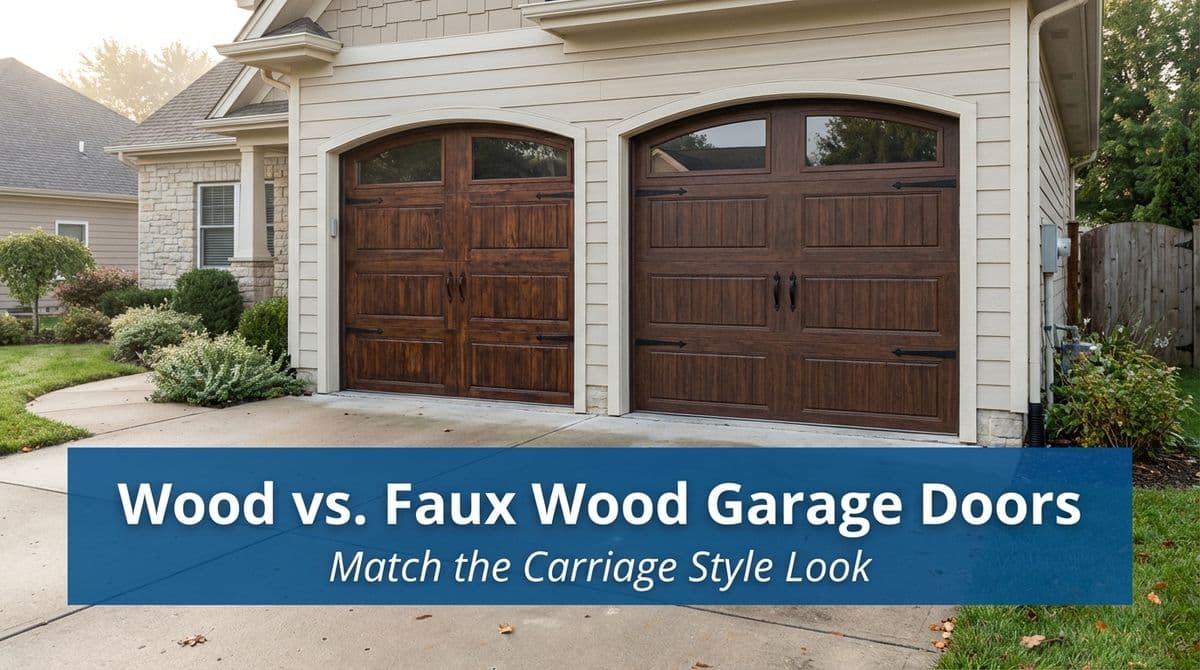
A Homeowner Looking for the Carriage Look Without the Headache
We recently got a call from a customer — let’s call him Jake — who was helping his boss replace a pair of beautiful wood carriage-style garage doors. The doors were classic: arch top, vertical slats, decorative hardware, no windows. Gorgeous… from across the street.
Up close, though, the story was different. A previous sanding job had gone wrong, the finish was never quite right again, and the owner had been annoyed with them ever since. Jake told me, “He wants the same high-end carriage look, but he’s tired of the sanding, staining, and touch-ups.”
That’s a conversation we have a lot: homeowners love the rich, traditional look of wood carriage doors, but not the price tag or maintenance. So let’s walk through how we usually help people like Jake decide between real wood and faux wood doors — and how to match that high-end carriage style look without the high cost or headache.
Why True Wood Carriage Doors Are So Expensive
When Jake asked if we still do real wood doors, I told him the truth: yes, but they’re almost all semi-custom or full custom now, and the cost has gone through the roof.
For a setup like his — a 16×7 and a 9×7 with an arch top and carriage hardware — a comparable steel carriage-style door with a wood-grain finish might run in the ballpark of $4,000–$5,000 for the large door. A similar design in real wood can easily land in the $10,000–$12,000 range just for that one door, depending on species and detailing.
The reason is simple: fewer manufacturers make them, they’re labor-intensive, and the materials aren’t cheap. Add in freight, finishing, and installation, and you’re paying a premium for what is essentially a specialty product.
The Other Cost of Wood: Ongoing Maintenance
Price is only half the story. The other half is what Jake’s boss was already dealing with: upkeep.
- Refinishing: Wood doors need periodic sanding and re-staining or painting.
- Weather exposure: Sun, snow, and moisture can cause warping, cracking, or peeling.
- Color consistency: One bad sanding or stain job and the look is never quite the same.
If you love working with wood and don’t mind regular maintenance, real wood can be worth it. But most homeowners tell us the same thing Jake did: “We want that look, without the constant work.” That’s where faux wood over steel really shines.
Faux Wood Garage Doors: Carriage Style Without the Drama
When Jake asked, “Can you do a wood overlay on a steel door?” we talked through modern faux wood options. Today’s steel carriage-style doors are designed to mimic real wood so well that most people can’t tell the difference from the curb.
Here’s what we typically recommend for situations like his:
- Steel door with insulated core: A durable, insulated steel base door (often polyurethane or polystyrene insulated) for strength and temperature control.
- Wood-grain finish: A factory-applied faux wood texture and color that mimics species like cedar, oak, or walnut.
- Carriage-style details: Vertical “plank” patterns, optional arch-top designs, and decorative hardware to match that classic carriage look.
Manufacturers like Clopay even offer faux wood doors up to around R-18 insulation, as well as more moderate options if your garage isn’t heated — which was the case for Jake’s boss. For most unheated garages, we typically recommend something in the mid-range, like an R-6 to R-8 door, instead of maxing out the R-value just for the numbers.
Finish Options: Pre-Finished vs. Stainable Faux Wood
One of Jake’s big questions was color. His boss liked the existing wood tone and wanted something close. We talked through two main paths:
- Factory pre-finished: Doors that arrive in a set faux wood color from the manufacturer. These are very low maintenance — no sanding, no staining, just occasional cleaning. For most homeowners, this is the sweet spot.
- Stainable faux wood: Some doors come with an unfinished faux wood surface designed to be stained in the field. This is ideal if you’re trying to match trim, entry doors, or HOA requirements. You still get the durability of steel, but with more control over color.
The key advantage either way: you’re not dealing with a soft, weather-vulnerable wood surface. The “wood” you see is a durable finish on steel, so the door holds its look for years with minimal care.
How We Help Homeowners Decide
With Jake, our next step was simple: I emailed him a quick form and asked for photos of the existing doors — front view, close-ups of the arch and hardware, and a shot from the street. Once we see what you have, we can usually recommend a few specific models that match your style closely.
When we’re helping someone choose between real wood and faux wood carriage doors, we walk through three main questions:
- What’s your budget? If you want that classic carriage look without jumping into five-figure territory, faux wood over steel is almost always the smarter choice.
- How much maintenance do you want? If you’d prefer not to deal with sanding, staining, and touch-ups every few years, go faux wood.
- How close do we need to match? With good photos, we can usually get very close to your current design — arch tops, hardware style, panel layout, and color.
Getting the High-End Look Without the High-End Hassle
If you’re standing in your driveway looking at tired wood carriage doors — or thinking about upgrading from plain raised-panel doors — you don’t have to choose between beauty and practicality.
Real wood doors will always have a place, but for most homeowners who want that elegant carriage style, modern faux wood steel doors deliver:
- The rich, detailed look you want
- Far lower upfront cost than custom wood
- Minimal maintenance over the life of the door
If you’d like to see what a faux wood carriage-style door could look like on your home, snap a few photos of your current doors and reach out. Just like we did for Jake, we’ll walk you through options that match your style, your budget, and your tolerance for maintenance — so you get the high-end look, without the high-end headache.